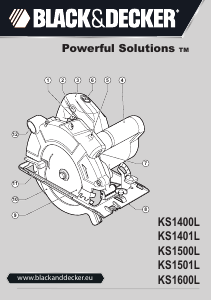
Mode d’emploi Black and Decker KS1401L Scie circulaire

Besoin d'un mode d’emploi pour votre Black and Decker KS1401L Scie circulaire ? Ci-dessous, vous pouvez consulter et télécharger gratuitement le mode d’emploi PDF en français. Ce produit a actuellement 3 questions fréquemment posées, 0 commentaires et 0 votes. Si ce n'est pas le mode d’emploi que vous souhaitez, veuillez nous contacter.

Votre produit est défectueux et le mode d’emploi n’offre aucune solution ? Rendez-vous à un Repair Café pour obtenir des services de réparation gratuits.

Mode d’emploi

Loading…

6
ENGLISH
f. Keep cutting tools sharp and clean. Properly maintained
cutting tools with sharp cutting edges are less likely to
bind and are easier to control.
g. Use the power tool, accessories and tool bits etc. in
accordance with these instructions, taking into
account the working conditions and the work to be
performed. Use of the power tool for operations different
from those intended could result in a hazardous situation.
5. Service
a. Haveyourpowertoolservicedbyaqualiedrepair
person using only identical replacement parts. This will
ensure that the safety of the power tool is maintained.
Additional power tool safety warnings
@
Warning! Additional safety warnings for saws
a. Keep hands away from cutting area and the blade.
Keep your second hand on auxiliary handle, or motor
housing. If both hands are holding the saw, they cannot
be cut by the blade.
b. Do not reach underneath the workpiece. The guard
cannot protect you from the blade below the workpiece.
c. Adjust the cutting depth to the thickness of the
workpiece. Less than a full tooth of the blade teeth should
be visible below the workpiece.
d. Never hold piece being cut in your hands or across
your leg. Secure the workpiece to a stable platform.
It is important to support the work properly to minimize
body exposure, blade binding, or loss of control.
e. Hold power tool by insulated gripping surfaces when
performing an operation where the cutting tool may
contact hidden wiring or its own cord. Contact with a
"live" wire will also make exposed metal parts of the power
tool "live" and shock the operator.
f. When ripping always use a rip fence or straight edge
guide. This improves the accuracy of cut and reduces the
chance of blade binding.
g. Always use blades with correct size and shape
(diamond versus round) of arbour holes. Blades that
do not match the mounting hardware of the saw will run
eccentrically, causing loss of control.
h. Never use damaged or incorrect blade washers or
bolt. The blade washers and bolt were specially designed
for your saw, for optimum performance and safety of
operation.
Further safety instructions for all saws
Causes and operator prevention of kickback:
u kickback is a sudden reaction to a pinched, bound or
misaligned saw blade, causing an uncontrolled saw to lift
up and out of the workpiece toward the operator;
u when the blade is pinched or bound tightly by the kerf
closing down, the blade stalls and the motor reaction
drives the unit rapidly back toward the operator;
u if the blade becomes twisted or misaligned in the cut, the
teeth at the back edge of the blade can dig into the top
surface of the wood causing the blade to climb out of the
kerf and jump back toward the operator.
Kickback is the result of saw misuse and/or incorrect operating
procedures or conditions and can be avoided by taking proper
precautions as given below.
a. Maintainarmgripwithbothhandsonthesawand
position your arms to resist kickback forces. Position
your body to either side of the blade, but not in line
with the blade. Kickback could cause the saw to jump
backwards, but kickback forces can be controlled by the
operator, if proper precautions are taken.
b. When the blade is binding, or when interrupting a cut
for any reason, release the trigger and hold the saw
motionless in the material until the blade comes to a
complete stop. Never attempt to remove the saw from
the work or pull the saw backward while the blade is
in motion or kickback may occur. Investigate and take
corrective actions to eliminate the cause of blade binding.
c. When restarting a saw in the workpiece, centre the
saw blade in the kerf and check that saw teeth are not
engaged into the material. If saw blade is binding, it may
walk up or kickback from the workpiece as the saw is
restarted.
d. Support large panels to minimise the risk of blade
pinching and kickback. Large panels tend to sag under
their own weight. Supports must be placed under the
panel on both sides, near the line of cut and near the edge
of the panel.
e. Do not use dull or damaged blades. Unsharpened or
improperly set blades produce narrow kerf causing
excessive friction, blade binding and kickback.
f. Blade depth and bevel adjusting locking levers must
be tight and secure before making cut. If blade
adjustment shifts while cutting, it may cause binding and
kickback.
g. Use extra caution when making a "plunge cut" into
existing walls or other blind areas. The protruding blade
may cut objects that can cause kickback.
Télécharger mode d’emploi en Français (PDF, 1.01 MB)
(Tenez compte de l’environnement et imprimez ce manuel uniquement si c’est vraiment nécessaire)

Loading…

Évaluation

Dites-nous ce que vous pensez du Black and Decker KS1401L Scie circulaire en laissant une note de produit. Vous voulez partager vos expériences avec ce produit ou poser une question ? Veuillez laisser un commentaire au bas de la page.
Etes-vous satisfait du Black and Decker KS1401L Scie circulaire ?
Oui Non
Soyez le premier à évaluer ce produit
0 évaluations

Joignez-vous à la conversation sur ce produit

Ici, vous pouvez partager ce que vous pensez du Black and Decker KS1401L Scie circulaire. Si vous avez une question, lisez d’abord attentivement le mode d’emploi. La demande d’un mode d’emploi peut être effectuée en utilisant notre formulaire de contact.

En savoir plus sur ce mode d’emploi

Nous comprenons qu’il est agréable d’avoir un mode d’emploi papier pour vos Black and Decker KS1401L Scie circulaire. Vous pouvez toujours télécharger le mode d’emploi depuis notre site Web et l’imprimer vous-même. Si vous souhaitez disposer d’un mode d’emploi original, nous vous recommandons de contacter Black and Decker. Ils pourront peut-être fournir un mode d’emploi original. Recherchez-vous le mode d’emploi de votre Black and Decker KS1401L Scie circulaire dans une autre langue ? Choisissez votre langue préférée sur notre page d’accueil et recherchez le numéro de modèle pour voir si nous l’avons disponible.

Caractéristiques

Marque Black and Decker
Modèle KS1401L
Catégorie Scies circulaires
Type de fichier PDF
Taille du fichier 1.01 MB

Tous les modes d’emploi pour Black and Decker Scies circulaires
Plus de modes d’emploi de Scies circulaires

Foire aux questions sur Black and Decker KS1401L Scie circulaire

Notre équipe d’assistance recherche des informations utiles sur les produits et des réponses aux questions fréquemment posées. Si vous trouvez une inexactitude dans notre foire aux questions, veuillez nous le faire savoir en utilisant notre formulaire de contact.

De combien de millimètres la scie doit-elle dépasser sous le matériau que je scie ? Vérifié

Il est préférable de la maintenir à 3 mm ou plus. Lorsqu’elle est inférieure, il y a un risque que le matériau s’effrite ou qu’il donne un mauvais résultat.

Cela a été utile (110) En savoir plus

Dois-je porter une protection auditive lorsque j'utilise une scie circulaire ? Vérifié

Oui, vous devriez. Bien que la quantité de bruit produite par une scie circulaire varie selon les marques et les modèles, une exposition prolongée aux bruits forts peut entraîner des lésions auditives permanentes. C'est pourquoi il est judicieux de porter une protection auditive.

Cela a été utile (53) En savoir plus

Puis-je ranger des outils électriques dans un hangar ou un garage ? Vérifié

En général, vous pouvez ranger les outils électriques dans un cabanon ou un garage, même s'il y gèle parfois. Cependant, pour préserver la durée de vie de l'outil électrique, il est préférable de le stocker dans un endroit sec et sans variations de température importantes. Dans une remise ou un garage, les différences de température peuvent provoquer la formation de condensation, ce qui peut provoquer de la rouille. De plus, les outils fonctionnant sur piles durent moins longtemps et se chargent moins bien à des températures très basses. Pour être sûr de la manière dont votre outil électrique doit être stocké, lisez toujours attentivement le manuel d'utilisation.

Cela a été utile (27) En savoir plus
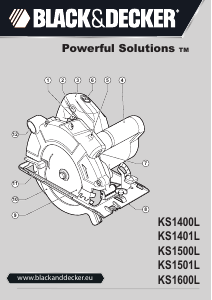
Mode d’emploi Black and Decker KS1401L Scie circulaire

Produits connexes

Catégories associées

×
Download