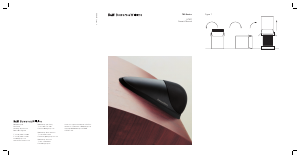
Mode d’emploi Bowers and Wilkins Nautilus 801 Haut-parleur

Besoin d'un mode d’emploi pour votre Bowers and Wilkins Nautilus 801 Haut-parleur ? Ci-dessous, vous pouvez consulter et télécharger gratuitement le mode d’emploi PDF en français. Ce produit a actuellement 5 questions fréquemment posées, 0 commentaires et 0 votes. Si ce n'est pas le mode d’emploi que vous souhaitez, veuillez nous contacter.

Votre produit est défectueux et le mode d’emploi n’offre aucune solution ? Rendez-vous à un Repair Café pour obtenir des services de réparation gratuits.

Mode d’emploi

Loading…

because you do not want to see a
multitude of cables in the room, short
cables are provided to link both positive
and both negative speaker terminals
together.
When using the links, insert the spade into
the slot in the side of one terminal and the
crimped pin into the round side hole in the
other. There is enough clearance to insert a
spade connector from the amplifier into the
same terminal as the crimped pin.
Ensure each positive terminal on the
speaker (coloured red) is connected to the
positive output terminal of the amplifier and
negative (coloured black) to negative.
Incorrect connection can result in poor
imaging and loss of bass.
When bi-wiring, do not use the linking
cables. Take extra care with the polarity of
the connections as incorrect connection
can also impair the frequency response
through the bass-midrange crossover and,
if the links are left in place, may cause
damage to the amplifier by shorting its
output terminals.
Fine tuning
Before fine tuning, double check that all the
connections in the installation are correct
and secure.
Moving the speakers further from the walls
will reduce the general level of bass. Space
behind the speakers also helps to create an
impression of depth. Conversely, moving
the speakers closer to the walls will
increase the level of bass.
If the bass is uneven with frequency it is
usually due to the excitation of resonance
modes in the room.
Even small changes in the position of the
speakers or the listeners can have a
profound effect on how these resonances
affect the sound. Try mounting the
speakers along a different wall. Even
moving large pieces of furniture can have
an effect.
If the central image is poor, try moving the
speakers closer together or toeing them in
so they point at or just in front of the
listeners. (figure 4)
If the sound is too harsh, increase the
amount of soft furnishing in the room (for
example use heavier curtains), or reduce it
if the sound is dull and lifeless.
Test for flutter echoes by clapping your
hands and listening for rapid repetitions.
Reduce them by the use of irregular
shaped surfaces such as bookshelves and
large pieces of furniture.
For the most discerning listening, remove
the bass and midrange grilles as described
below in the section “Aftercare”. The
tweeter is very delicate and its grille should
be left in position for protection.
For this reason the grille retaining ring is
designed to provide the optimum acoustic
environment for the unit and the response
is less smooth with the grille removed.
Running-in period
The performance of the speaker will change
subtly during the initial listening period. If
the speaker has been stored in a cold
environment, the damping compounds and
suspension materials of the drive units will
take some time to recover their correct
mechanical properties. The drive unit
suspensions will also loosen up during the
first hours of use. The time taken for the
speaker to achieve its intended
performance will vary depending on
previous storage conditions and how it is
used. As a guide, allow up to a week for
the temperature effects to stabilise and 15
hours of average use for the mechanical
parts to attain their intended design
characteristics.
Ancillary equipment
Speakers of this ability deserve signals of
the highest quality. Choose your electronic
equipment and interconnecting cables with
care. We can give guidance on what to
look for when choosing ancillary
equipment, but cannot recommend specific
items. The standards of such products are
improving all the time and your dealer will
be able to demonstrate a variety of suitable
up-to-date products.
In the specification we recommend a range
of amplifier powers. The higher figure is
defined by the power handling capability of
the speaker. When calculating the power
handling, it is assumed that the amplifier is
not run into clipping, which distorts the
frequency power spectrum of the signal,
and that the signal is normal programme
material. Test tones from oscillators and the
like are not applicable. The lower figure is
the minimum we consider necessary to
achieve reasonable listening levels without
audible distortion in the smaller room (less
than 60 m
3
or 2000 cu ft). The higher the
power you use, the less likely you are to
experience amplifier clipping. You can often
tell how good an amplifier is at driving
complex speaker loads by looking at its
power rating into both 4 and 8 loads.
The nearer the ratio is to 2:1 the better, as
it indicates a good current capability.
In order to reduce the effect the cable has
on the frequency response of the speaker
to inaudible levels, the impedance of the
cable at all frequencies (measuring both
positive and negative conductors in series)
should be kept as low as possible and
certainly below 0.1. At low frequencies,
the DC resistance of the cable is the
dominant factor and you should choose a
gauge of wire sufficient to achieve the
impedance requirements over the length of
cable you need to use. At mid and high
frequencies the inductive component of the
impedance can dominate the DC
resistance. This and other properties
influenced by the detailed construction of
the cable become important. Ask your
dealer for advice on the best cable for your
needs.
Aftercare
The bass cabinet surface usually only
requires dusting, but the gloss surface of
midrange and tweeter housings will benefit
from the use of an anti-static cleaner. If you
wish to use an aerosol cleaner, remove the
cloth covered grilles first and spray onto
the cleaning cloth, not directly onto the
cabinet. Do not attempt to remove the
tweeter grille.
Remove both cloth covered grilles by
gripping at the outer edges and gently
pulling away from the cabinet. To replace
the bass grille, locate the pegs in the holes
in the bass unit trim ring (Nautilus™801) or
the cabinet (Nautilus™802) and push into
place. To replace the midrange grille, locate
the central peg in the hole in the tip of the
bullet shaped dispersion modifier at the
centre of the drive unit and push the centre
of the grille firmly. The outer rim of the grille
is held in place by spring tension in the
spokes of the grille fret.
The grille fabric may be cleaned with the
brush provided while the grille is detached
from the cabinet.
Avoid touching the drive unit diaphragms,
especially the tweeter, as damage may
result.
2
Télécharger mode d’emploi en Français (PDF, 3.77 MB)
(Tenez compte de l’environnement et imprimez ce manuel uniquement si c’est vraiment nécessaire)

Loading…

Évaluation

Dites-nous ce que vous pensez du Bowers and Wilkins Nautilus 801 Haut-parleur en laissant une note de produit. Vous voulez partager vos expériences avec ce produit ou poser une question ? Veuillez laisser un commentaire au bas de la page.
Etes-vous satisfait du Bowers and Wilkins Nautilus 801 Haut-parleur ?
Oui Non
Soyez le premier à évaluer ce produit
0 évaluations

Joignez-vous à la conversation sur ce produit

Ici, vous pouvez partager ce que vous pensez du Bowers and Wilkins Nautilus 801 Haut-parleur. Si vous avez une question, lisez d’abord attentivement le mode d’emploi. La demande d’un mode d’emploi peut être effectuée en utilisant notre formulaire de contact.

En savoir plus sur ce mode d’emploi

Nous comprenons qu’il est agréable d’avoir un mode d’emploi papier pour vos Bowers and Wilkins Nautilus 801 Haut-parleur. Vous pouvez toujours télécharger le mode d’emploi depuis notre site Web et l’imprimer vous-même. Si vous souhaitez disposer d’un mode d’emploi original, nous vous recommandons de contacter Bowers and Wilkins. Ils pourront peut-être fournir un mode d’emploi original. Recherchez-vous le mode d’emploi de votre Bowers and Wilkins Nautilus 801 Haut-parleur dans une autre langue ? Choisissez votre langue préférée sur notre page d’accueil et recherchez le numéro de modèle pour voir si nous l’avons disponible.

Caractéristiques

Marque Bowers and Wilkins
Modèle Nautilus 801
Catégorie Haut-parleurs
Type de fichier PDF
Taille du fichier 3.77 MB

Tous les modes d’emploi pour Bowers and Wilkins Haut-parleurs
Plus de modes d’emploi de Haut-parleurs

Foire aux questions sur Bowers and Wilkins Nautilus 801 Haut-parleur

Notre équipe d’assistance recherche des informations utiles sur les produits et des réponses aux questions fréquemment posées. Si vous trouvez une inexactitude dans notre foire aux questions, veuillez nous le faire savoir en utilisant notre formulaire de contact.

Je veux connecter un haut-parleur à mon téléviseur avec HDMI, quel port dois-je utiliser ? Vérifié

Vous devez utiliser le port HDMI-ARC, qui est spécialement conçu pour connecter un équipement audio.

Cela a été utile (1487) En savoir plus

Qu'est-ce que les fréquences m’apprennent sur mon haut-parleur ? Vérifié

Elles indiquent les plages de fréquences que le haut-parleur peut produire. Une plage de fréquences plus élevée fournira une plus grande variation de qualité et de production sonore.

Cela a été utile (794) En savoir plus

Quand la musique est-elle trop forte ? Vérifié

Les sons supérieurs à 80 décibels (dB) peuvent commencer à endommager l'audition. Les sons supérieurs à 120 décibels endommagent immédiatement l’audition. La gravité du dommage dépend de la fréquence et de la durée pendant lesquelles le son est présent.

Cela a été utile (476) En savoir plus

Est-ce que le Bluetooth fonctionne à travers les murs et les plafonds ? Vérifié

Un signal Bluetooth fonctionnera à travers les murs et le plafond, à moins qu’ils ne soient en métal. Selon l’épaisseur et le matériau de la paroi, le signal peut perdre en intensité.

Cela a été utile (237) En savoir plus

Jusqu’à quel niveau de bruit est-ce sans danger pour les enfants ? Vérifié

Les enfants ont leur audition endommagée plus rapidement que les adultes. Il est donc important de ne jamais exposer les enfants à un bruit supérieur à 85 dB. Dans le cas des écouteurs, il existe des modèles spéciaux pour les enfants. Dans le cas de haut-parleurs ou d’autres situations, vous devez faire attention à ce que le bruit ne dépasse pas ce niveau.

Cela a été utile (212) En savoir plus
Mode d’emploi Bowers and Wilkins Nautilus 801 Haut-parleur

Produits connexes

Catégories associées

×
Download