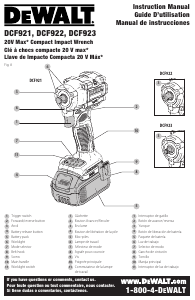
Mode d’emploi DeWalt DCF923P2 Visseuse à choc

Besoin d'un mode d’emploi pour votre DeWalt DCF923P2 Visseuse à choc ? Ci-dessous, vous pouvez consulter et télécharger gratuitement le mode d’emploi PDF en français. Ce produit a actuellement 1 de question fréquemment posée, 0 de commentaires et 0 votes. Si ce n'est pas le mode d’emploi que vous souhaitez, veuillez nous contacter.

Votre produit est défectueux et le mode d’emploi n’offre aucune solution ? Rendez-vous à un Repair Café pour obtenir des services de réparation gratuits.

Mode d’emploi

Loading…

ENGLISH
6
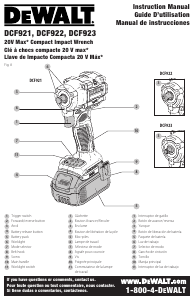
Installing and Removing the Battery Pack (Fig.D)
NOTE: For best results, make sure your battery pack is
fullycharged.
To install the battery pack
5
into the tool handle, align the
battery pack with the rails inside the tool’s handle and slide
it into the handle until the battery pack is firmly seated in
the tool and ensure that it does notdisengage.
OPERATION
WARNING: To reduce the risk of serious personal
injury, turn unit off and remove the battery pack
before making any adjustments or removing/installing
attachments or accessories. An accidental start‑up can
causeinjury.
Belt Hook (Fig.A)
Included with Some Models
WARNING: To reduce the risk of serious personal
injury, ONLY use the tool's belt hook to hang the tool
from a work belt. DO NOT use the belt hook for tethering
or securing the tool to a person or object during use. DO NOT
suspend tool overhead or suspend objects from the belthook.
Anvil With Hog Ring (Fig.C)
DCF921, DCF923
To install an accessory on the hog ring anvil, firmly push
accessory onto the anvil
3
. The hog ring
12
compresses
to allow the accessory to slide on. After accessory is
installed, the hog ring applies pressure to help provide
accessoryretention.
To remove an accessory, grasp the accessory and firmly pull
itoff.
Mode Selector (Fig.A, B)
Your tool is equipped with a mode selector
7
which allows
you to select one of two speeds, Timber Screw™ mode, or
Precision Wrench™ mode. Select the mode based on the
maximum speed/torque needed and control the speed of
the tool using the variable speed trigger switch
1
.
Timber Screw™ Mode (Fig.B)
Timber Screw™ mode optimizes tool performance to help
increase the speed of wood driving applications such as
with lag bolts, lag screws and structural woodscrews.
Precision Wrench™ Mode (Fig.B)
In addition to normal impacting modes, this tool features
the Precision Wrench™ mode which grants the user greater
control in both fastening and loosening applications.
When set in forward, the tool will fasten at 2500RPM until
impact begins. The tool will then pause for 0.5 seconds
before continuing to impact at a rate of 3550IPM, providing
the user with greater control and reducing the chance of
overtightening or damagingmaterial.
When set in reverse, the tool will impact at a normal speed
and rate of 3550IPM. Upon sensing that the fastener has
broken free, the tool will cease to impact and will reduce
speed to help prevent “run‑off” of loosehardware.
Specifications
Mode Application RPM
Precision Wrench Precision Wrench 0‑2500 forward
0‑2500 reverse
Timber Screw Timber Screw 0‑2500 forward
0‑2500 reverse
Speed 1 Low Speed Impacting 0‑1400 forward
0‑2500 reverse
Speed 2 High Speed Impacting 0‑2500 forward
0‑2500 reverse
WARNING: To reduce the risk of serious personal
injury, ensure the screw holding the belt hook issecure.
IMPORTANT: When attaching or replacing a belt hook, use
only the screw that is provided. Be sure to securely tighten
thescrew.
A belt hook
8
can be attached to either side of the tool
using only the screw
9
provided, to accommodate left‑ or
right‑handed users. If the belt hook is not desired at all, it
can be removed from thetool.
To move the belt hook, remove the screw
9
that holds it
in place then reassemble on the opposite side. Be sure to
securely tighten thescrew.
Anvil (Fig.C)
WARNING: Use only impact accessories. Non‑impact
accessories may break and cause a hazardous condition.
Inspect accessory prior to use to ensure that it contains
nocracks.
CAUTION: Inspect anvils, detent pins, and hog rings
prior to use. Missing or damaged items should be replaced
beforeuse.
Place the switch in the locked off (center) position or
remove battery pack before changingaccessories.
Anvil with Detent Pin (Fig.C)
DCF922
To install an accessory on the anvil, align the hole in the side
of the accessory with the detent pin
13
on the anvil
3
.
Press the accessory on until the detent pin engages in the
hole. Depression of detent pin may be necessary to aid
installation ofaccessory.
To remove an accessory, depress the detent pin through the
hole and pull the accessoryoff.
ASSEMBLY AND ADJUSTMENTS
WARNING: To reduce the risk of serious personal
injury, turn unit off and remove the battery pack
before making any adjustments or removing/installing
attachments or accessories. An accidental start‑up can
causeinjury.
sfpm ................... surface feet per
minute
SPM .................... strokes per minute
A ......................... amperes
W ........................watts
Wh ......................watt hours
Ah ....................... amp hours
or AC ...........alternating current
or AC/DC .... alternating or
direct current
...................... Class II
Construction
(double insulated)
n
o
.......................no load speed
n .........................rated speed
PSI....................... pounds per square
inch
......................earthing terminal
.....................safety alert symbol
..................... visible radiation
do not stare into
the light
..................... wear respiratory
protection
..................... wear eye
protection
..................... wear hearing
protection
..................... read all
documentation
Télécharger mode d’emploi en Français (PDF, 2.64 MB)
(Tenez compte de l’environnement et imprimez ce manuel uniquement si c’est vraiment nécessaire)

Loading…

Évaluation

Dites-nous ce que vous pensez du DeWalt DCF923P2 Visseuse à choc en laissant une note de produit. Vous voulez partager vos expériences avec ce produit ou poser une question ? Veuillez laisser un commentaire au bas de la page.
Etes-vous satisfait du DeWalt DCF923P2 Visseuse à choc ?
Oui Non
Soyez le premier à évaluer ce produit
0 évaluations

Joignez-vous à la conversation sur ce produit

Ici, vous pouvez partager ce que vous pensez du DeWalt DCF923P2 Visseuse à choc. Si vous avez une question, lisez d’abord attentivement le mode d’emploi. La demande d’un mode d’emploi peut être effectuée en utilisant notre formulaire de contact.

En savoir plus sur ce mode d’emploi

Nous comprenons qu’il est agréable d’avoir un mode d’emploi papier pour vos DeWalt DCF923P2 Visseuse à choc. Vous pouvez toujours télécharger le mode d’emploi depuis notre site Web et l’imprimer vous-même. Si vous souhaitez disposer d’un mode d’emploi original, nous vous recommandons de contacter DeWalt. Ils pourront peut-être fournir un mode d’emploi original. Recherchez-vous le mode d’emploi de votre DeWalt DCF923P2 Visseuse à choc dans une autre langue ? Choisissez votre langue préférée sur notre page d’accueil et recherchez le numéro de modèle pour voir si nous l’avons disponible.

Caractéristiques

Marque DeWalt
Modèle DCF923P2
Catégorie Visseuses à chocs
Type de fichier PDF
Taille du fichier 2.64 MB

Tous les modes d’emploi pour DeWalt Visseuses à chocs
Plus de modes d’emploi de Visseuses à chocs

Foire aux questions sur DeWalt DCF923P2 Visseuse à choc

Notre équipe d’assistance recherche des informations utiles sur les produits et des réponses aux questions fréquemment posées. Si vous trouvez une inexactitude dans notre foire aux questions, veuillez nous le faire savoir en utilisant notre formulaire de contact.

Puis-je ranger des outils électriques dans un hangar ou un garage ? Vérifié

En général, vous pouvez ranger les outils électriques dans un cabanon ou un garage, même s'il y gèle parfois. Cependant, pour préserver la durée de vie de l'outil électrique, il est préférable de le stocker dans un endroit sec et sans variations de température importantes. Dans une remise ou un garage, les différences de température peuvent provoquer la formation de condensation, ce qui peut provoquer de la rouille. De plus, les outils fonctionnant sur piles durent moins longtemps et se chargent moins bien à des températures très basses. Pour être sûr de la manière dont votre outil électrique doit être stocké, lisez toujours attentivement le manuel d'utilisation.

Cela a été utile (18) En savoir plus
Mode d’emploi DeWalt DCF923P2 Visseuse à choc

Produits connexes

Catégories associées

×
Download