
3
UK
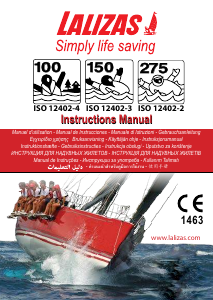
Instructions Manual
LALIZAS Adult Inatable Lifejackets can be used by a User weighting a minimum of 40kg and with a Chest girth of 70-150cm.
LALIZAS Child Inatable Lifejackets can be used by a User weighting a minimum of 25kg and a maximum of 40kg and with a chest girth of 60-90cm.
Personal Flotation Device
Application Performance Level Applicable Standard
Intended primarily for offshore use under extreme conditions. Of value to those who are wearing
clothing which traps air and which may adversely affect the self-righting capacity of the Lifejacket.
Designed to ensure that the user is oating in the correct position with his mouth and nose clear
of the surface.
275 ISO 12402-2
Intended for general application or for use with foul weather clothing. It will turn an unconscious
person into a safe position and requires no subsequent action by the user to maintain this position.
150 ISO 12402-3
Intended for those who may have to wait for rescue, but they are likely to do so in sheltered waters.
The device should not be used in rough conditions.
100 ISO 12402-4
Manual gas ination Model (see Fig. 1): To inate pull the manual lever. Only activate if lifejacket is fully deated. Before Use ensure 24gr CO
2
gas
cylinder is tted to performance Level 100N adult Lifejackets or 33/38gr CO
2
gas cylinder is tted to Performance Level 150N adult Lifejackets or one
60gr CO
2
gas cylinder is tted to Performance Level 275N adult Lifejackets or one 24gr CO
2
Gas Cylinder to children’s lifejackets.
Automatic gas ination model (see Fig.2)/Automatic/Hydrostatic gas ination model (see attached leaets): On entering water this Lifejacket
will inate automatically. Hammar: On entering water this lifejacket will not inate automatically unless the inator is lowered more than about 4 inches
or so in the water. Before Use ensure 24gr CO
2
gas cylinder is tted to Performance Level 100N adult Lifejackets or 33/38gr CO
2
Gas Cylinder is tted
to Performance Level 150N adult Lifejackets or one 60gr CO
2
gas cylinder is tted to Performance Level 275N adult Lifejackets or one 24gr CO
2
Gas
Cylinder to children’s lifejackets. If the automatic ination for any reason does not operate, use the back-up manual inator by pulling the manual lever.
Oral Ination: Open the cap of the oral ination tube and blow in through the oral ination tube. Re-install the cap in the normal position on the ination
tube. Oral ination can only be used as a back- up if for any reason the Automatic and/or Manual Ination has not operated.
IMPORTANT: It is not a Personal Flotation Device until it is fully inated. Use only one 24gr CO
2
gas cylinder is tted to Performance Level 100N adult
Lifejackets or 33/38gr CO
2
Gas cylinder to Performance Level 150N adult lifejackets or one 60gr CO
2
gas cylinder is tted to 275N adult Lifejackets or
one 24gr CO
2
Gas Cylinder to children’s Lifejackets. Do not partially inate orally and then use CO
2
cylinder, as this action can damage the Lifejacket.
Before every use inspect your gas ination lifejacket. Check carefully that the lifejacket is not damaged, the CO
2
cylinder is properly screwed in. Also
check the operational readiness of the ination device, (See FIG 1 & 2) and that the manual lever hangs out freely. Train yourself in the use of the
device. Try out the Lifejacket to ascertain its performance before use. You can use oral ination when out of water to check the performance of the
Lifejacket. The lifejacket is tted with a whistle. Use it to call for help in case of emergency. Teach the child to oat in this Lifejacket. Full Performance
may not be achieved using waterproof clothing or in other circumstances. For children less than 6 years use automatically operating devices only.
WARNING: FLOTATION DEVICES ONLY REDUCE THE RISK OF DROWNING. THEY DO NOT GUARANTEE RESCUE! GAS CYLINDERS ARE
DANGEROUS GOODS AND MUST BE KEPT AWAY FROM CHILDREN AND NOT MISUSED!
Donning & Adjustment: Practice and training are required with the device before use. Don the lifejacket according to the given instructions (See FIG.
4). Fasten the Buckles. Adjust the webbing. Use the correct way to jump into the sea water with your Lifejacket. (See FIG. 5). Keep your body in an
upright position when entering the water to avoid possible injury. Do not Jump from a height of more than 3m.
How to deate the lifejacket (see Fig.6): To deate remove oral ination tube cap. Insert the nipple of the cap strap and hold into the valve. Apply
gentle pressure to the lifejacket and deate it. Re-install the cap in the normal position on the ination tube.
Cleaning Instructions: Occasionally rinse the lifejacket with fresh water or right after a use, rinsing after use in salty water is fully recommended.
Excess grease, oil or similar marks should be removed with warm soapy water. Never use a washing machine or any thumble drying method for your
lifejacket. Let it dry naturally before storing.
WARNING: For automatically activated Lifejackets, remove the water activated device (D) before rinsing the lifejacket and re-install it, when the
Lifejacket has dried thoroughly.
Repacking Instructions: Ensure that the Lifejacket is completely dry and deated. Fold it and check that the manual lever hangs freely (See Fig.7).
Use of a safety harness & Safety Line: Lifejackets integrated with harness (ISO 12401:2009) can be used with most CE Marked Lines approved to
ISO 12401:2009. Lifejackets with no integrated harness should be worn over a LALIZAS’ CE safety harness.
WARNING: The safety harness and safety lines are intended to prevent the user falling overboard. They do not provide protection against falls from a
height. The safety harness and safety lines may transmit very large forces. Only attach to strong hooking points or jack- lines. It is unsafe to wear an
integral harness lifejacket or a safety harness loose. The harness shall be worn tightly in order to be effective.
Maintenance-Storage Instructions: Store the Lifejacket in a dry place away from direct sunlight. Don’t expose the lifejacket to excessive heat. Do not
use as a cushion. Check if the CO
2
cylinder is perforated or damaged. In this case you should replace it. Check the state of the Lifejacket (inatable
chamber, buckles, whistles, webbings and harnesses). In case of a severe drop or signs of deterioration contact your local approved service station.
Spare parts need to be replaced after each use, or 3 years after the manufacturing date. Always check the manufacturing date.
Servicing Instructions: Your Lifejacket shall be serviced at least every year (and more frequently in case of intensive use)
Re-arm kits: Re-arm the Lifejacket, always using LALIZAS Re-arm kits. See FIG.1, FIG.2 & FIG.3: You must replace the CO
2
cylinder and place a
new green tag©, if the green tag is missing (FIG.1 & FIG 2). You must replace the water activated device (D) and the CO
2
cylinder if the Indicator
(G) is red (FIG. 2).
Lifetime of the lifejacket: 10years of the date of Manufacture.
WARRANTY: This product has a 3 years warranty from the date manufactured. The warranty covers all lifejackets registered via the LALIZAS website,
any products returned that are not registered with LALIZAS will not be considered for warranty. This warranty does not cover spare parts or any
damage due to lack of maintenance, or bad use, or accidental effects. LALIZAS company will not make any warranty repair without proof of purchase.


Joignez-vous à la conversation sur ce produit
Ici, vous pouvez partager ce que vous pensez du Lalizas 275 Gilet de sauvetage. Si vous avez une question, lisez d’abord attentivement le mode d’emploi. La demande d’un mode d’emploi peut être effectuée en utilisant notre formulaire de contact.