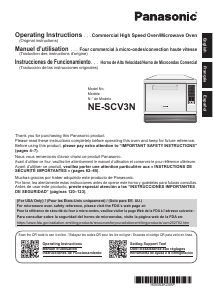
Mode d’emploi Panasonic NE-SCV3N Micro-onde

Besoin d'un mode d’emploi pour votre Panasonic NE-SCV3N Micro-onde ? Ci-dessous, vous pouvez consulter et télécharger gratuitement le mode d’emploi PDF en français. Ce produit a actuellement 7 questions fréquemment posées, 0 commentaires et 0 votes. Si ce n'est pas le mode d’emploi que vous souhaitez, veuillez nous contacter.

Votre produit est défectueux et le mode d’emploi n’offre aucune solution ? Rendez-vous à un Repair Café pour obtenir des services de réparation gratuits.

Mode d’emploi

Loading…
4 5
English
Your oven is a cooking device and you should use as much care as you use with a stove or any
other cooking device.
When using this electric appliance, basic safety precautions should be followed, including the
following:
WARNING
– To reduce the risk of burns, electric shock, fire, injury to persons or exposure
to excessive microwave energy:
1. Read all instructions before using the appliance.
2. Read and follow “PRECAUTIONS TO AVOID POSSIBLE EXPOSURE TO EXCESSIVE
MICROWAVE ENERGY,” found on page 3.
3. This appliance must be grounded. Connect only to a properly grounded outlet. See
“GROUNDING INSTRUCTIONS” found on page 8.
4. Install or locate this appliance only in accordance with the provided installation instructions found
on page 8.
5. Do not cover, or block any openings on this appliance.
6. Do not store, or use this appliance outdoors. Do not use this product near water for example,
near a kitchen sink, in a wet basement, or near a swimming pool, or similar locations.
7. Use this appliance only for its intended use as described in this manual. Do not use corrosive
chemicals or vapors in this appliance. This type of oven is specifically designed to heat, or cook
food. It is not designed for industrial or laboratory use.
8. When cleaning surfaces of door and oven that come together on closing the door, use only mild,
non-abrasive soaps or detergents applied with a sponge or soft cloth.
9. This appliance is not intended for use by persons (including children) with reduced physical,
sensory or mental capabilities, or lack of experience and knowledge, unless they have been given
supervision or instruction concerning use of the appliance by a person responsible for their safety.
10. Children should be supervised to ensure that they do not play with the appliance.
11. DO NOT operate this appliance if it has a damaged cord or plug, is not working properly, or has
been damaged or dropped.
12. Do not immerse cord or plug in water.
13. Keep cord away from heated surfaces.
14. Do not let cord hang over edge of table or counter.
15. SUITABLE FOR SERVICING ONLY WHEN DE-ENERGIZED. This appliance should be serviced
only by qualified service personnel. Contact the nearest authorized service facility for
examination, repair or adjustment.
Do NOT remove the outer panel of the oven.
IMPORTANT SAFETY INSTRUCTIONS
Your safety and the safety of others are very important.
We have provided important safety messages in this manual and on your appliance.
Always read and obey all safety messages.
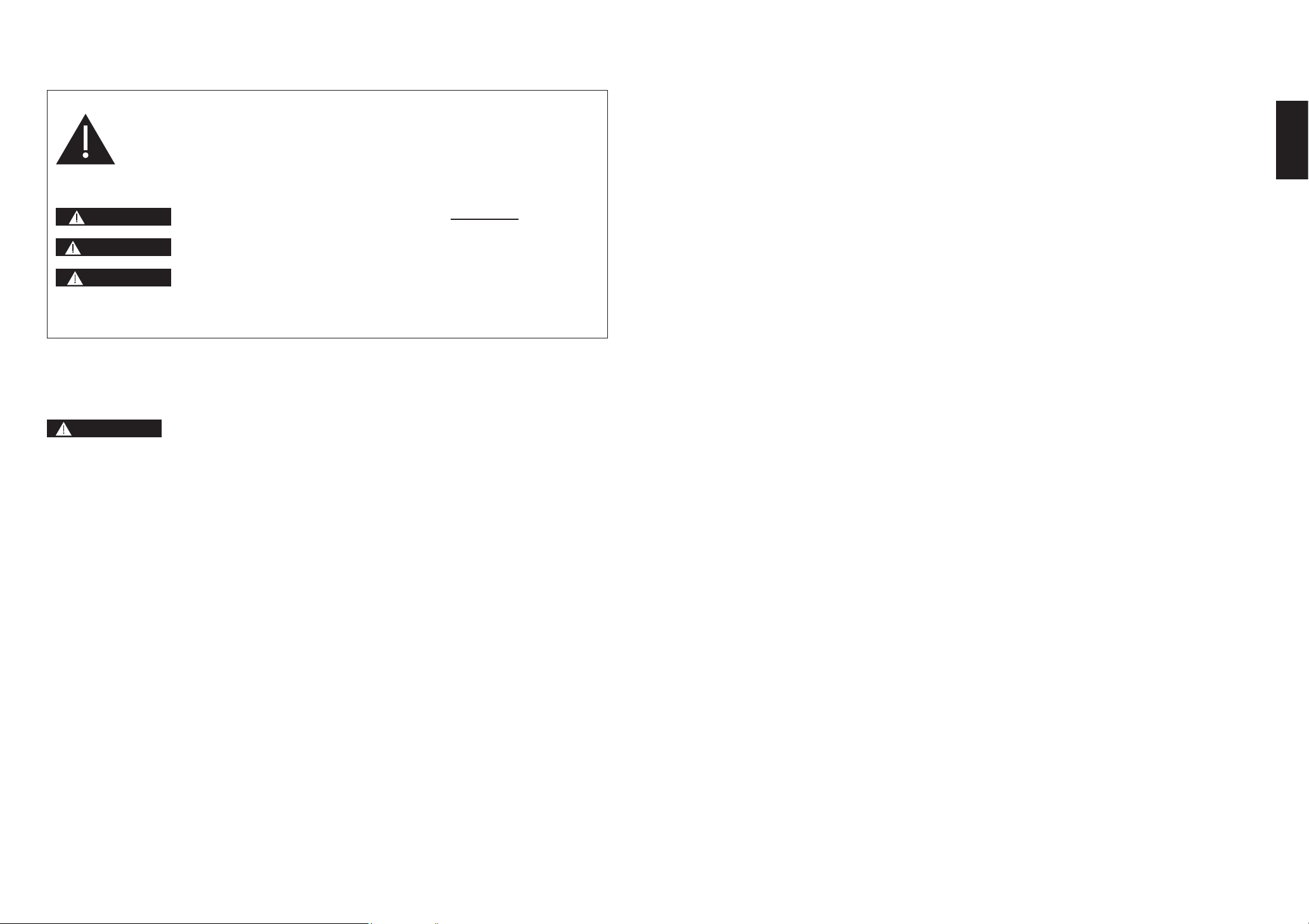
This is the safety alert symbol. It is used to alert you to potential hazards that can kill
or hurt you and others.
All safety messages will follow the safety alert symbol and either the word
“DANGER”, “WARNING” or “CAUTION”. These words mean:
DANGER
You can be killed or seriously injured if you don’t immediately follow
instructions.
WARNING
You can be killed or seriously injured if you don’t follow instructions.
CAUTION
You can be exposed to a potentially hazardous situation which, if not
avoided, may result in minor or moderate injury.
All safety messages will tell you what the potential hazard is, tell you how to reduce the chance
of injury, and tell you what can happen if the instructions are not followed.
16. Some products such as whole eggs and sealed containers (for example, closed glass jars) may
explode and should not be heated in this oven.
17. To reduce the risk of fire in the oven cavity:
(a) Do not overcook food. Carefully attend appliance when paper, plastic, or other combustible
materials are placed inside the oven to facilitate cooking.
(b) Remove wire twist-ties from paper or plastic bags before placing bag in oven.
(c) If materials inside the oven ignite, keep oven door closed, turn oven off, and disconnect the
power cord, or shut off power at the fuse or circuit breaker panel.
(d) Do not use the cavity for storage purposes.
Do not leave paper products, cooking utensils, or food in the cavity when not in use.
18. Liquids, such as water, coffee, or tea are able to be overheated beyond the boiling point without
appearing to be boiling due to surface tension of the liquid. Visible bubbling or boiling when the
container is removed from the microwave oven is not always present. THIS COULD RESULT IN
VERY HOT LIQUIDS SUDDENLY BOILING OVER WHEN THE CONTAINER IS DISTURBED
OR A UTENSIL IS INSERTED INTO THE LIQUID. To reduce the risk of injury to persons:
(a) Do not overheat the liquid.
(b) Stir the liquid both before and halfway through heating it.
(c) Do not use straight-sided containers with narrow necks.
(d) After heating, allow the container to stand in the oven for a short time before removing the
container.
(e) Use extreme care when inserting a spoon or other utensil into the container.
19. Only a combination of same models are allowed when stacking.
20. The contents of feeding bottles and baby food jars must be stirred or shaken and the
temperature checked before consumption, in order to avoid burns.
21. Microwave heating of beverages can result in delayed eruptive boiling, therefore care must be
taken when handling the container.
22. Floor at adjacent to the oven may be slippery, care should be taken.
23. Do not overturn or drop this oven or accessories. Doing so may cause injury, electric shock, or
microwave leakage.
24. Do not use the oven near an automatically controlled device such as an automatic door or a fire
alarm when you are using this oven via wireless LAN repeater.
Electromagnetic waves, originating from a wireless LAN, for example, can affect an
automatically controlled device, leading to malfunction that can cause an accident.
25. Do not use the oven in a hospital or near electrical medical devices when you are using this
oven via wireless LAN repeater.
Electromagnetic waves, originating from a wireless LAN, for example, can affect an electrical
medical device, leading to malfunction that can cause an accident.
26. Persons fitted with a pacemaker should keep the pacemaker at least 15 cm away from the
wireless LAN repeater when you are using this oven via wireless LAN repeater.
Electromagnetic waves, originating from a wireless LAN, for example, may affect the
pacemaker’s operation.
27. This appliance shall not be placed or installed where the public has access.
28. HOT CONTENTS CAN CAUSE SEVERE BURNS. DO NOT ALLOW CHILDREN TO USE THE
MICROWAVE. Use caution when removing hot items.
29. Oversized foods or oversized metal utensils should not be inserted in a microwave oven as they
may create a fire or risk of electric shock.
30. Do not clean with metal scouring pads. Pieces can burn off the pad and touch electrical parts
involving a risk of electric shock.
Télécharger mode d’emploi en Français (PDF, 11.6 MB)
(Tenez compte de l’environnement et imprimez ce manuel uniquement si c’est vraiment nécessaire)

Loading…

Évaluation

Dites-nous ce que vous pensez du Panasonic NE-SCV3N Micro-onde en laissant une note de produit. Vous voulez partager vos expériences avec ce produit ou poser une question ? Veuillez laisser un commentaire au bas de la page.
Etes-vous satisfait du Panasonic NE-SCV3N Micro-onde ?
Oui Non
Soyez le premier à évaluer ce produit
0 évaluations

Joignez-vous à la conversation sur ce produit

Ici, vous pouvez partager ce que vous pensez du Panasonic NE-SCV3N Micro-onde. Si vous avez une question, lisez d’abord attentivement le mode d’emploi. La demande d’un mode d’emploi peut être effectuée en utilisant notre formulaire de contact.

En savoir plus sur ce mode d’emploi

Nous comprenons qu’il est agréable d’avoir un mode d’emploi papier pour vos Panasonic NE-SCV3N Micro-onde. Vous pouvez toujours télécharger le mode d’emploi depuis notre site Web et l’imprimer vous-même. Si vous souhaitez disposer d’un mode d’emploi original, nous vous recommandons de contacter Panasonic. Ils pourront peut-être fournir un mode d’emploi original. Recherchez-vous le mode d’emploi de votre Panasonic NE-SCV3N Micro-onde dans une autre langue ? Choisissez votre langue préférée sur notre page d’accueil et recherchez le numéro de modèle pour voir si nous l’avons disponible.

Caractéristiques

Marque Panasonic
Modèle NE-SCV3N
Catégorie Micro-ondes
Type de fichier PDF
Taille du fichier 11.6 MB

Tous les modes d’emploi pour Panasonic Micro-ondes
Plus de modes d’emploi de Micro-ondes

Foire aux questions sur Panasonic NE-SCV3N Micro-onde

Notre équipe d’assistance recherche des informations utiles sur les produits et des réponses aux questions fréquemment posées. Si vous trouvez une inexactitude dans notre foire aux questions, veuillez nous le faire savoir en utilisant notre formulaire de contact.

Que faire si mon micro-ondes ne démarre pas lorsque j’appuie sur le bouton « Start » ? Vérifié

La plupart du temps, cela signifie que la porte du micro-ondes n’est pas bien fermée. Ouvrez et refermez la porte, puis réessayez.

Cela a été utile (3607) En savoir plus

Puis-je utiliser mon four micro-ondes lorsque le plateau tournant ne fonctionne pas ? Vérifié

Le plateau tournant permet de s'assurer que la chaleur est répartie uniformément. Lorsqu'il ne fonctionne pas, le four à micro-ondes ne peut pas être utilisé correctement. Faites-le réparer.

Cela a été utile (2145) En savoir plus

Le four à micro-ondes est branché mais il ne fonctionne pas. Pour quelle raison ? Vérifié

Il est possible que la porte ne ferme pas correctement. Pour des raisons de sécurité, un four à micro-ondes ne fonctionne pas tant que la porte n'est pas complètement fermée. Parfois, il y a moyen d'y remédier en ajustant la charnière de la porte.

Cela a été utile (1603) En savoir plus

La plaque de mica/carton à l’intérieur du four à micro-ondes s’est détachée. Puis-je quand même utiliser le micro-ondes ? Vérifié

Non, absolument pas. La plaque de mica/carton est le guide d’ondes qui distribue les micro-ondes. Remettez-le ou remplacez-le.

Cela a été utile (1407) En savoir plus

Mon four à micro-ondes continue de faire du bruit, même après qu’il a fini. Est-ce normal ? Vérifié

Oui, c’est un son normal. Le ventilateur refroidit le micro-ondes après utilisation. La durée dépend de la durée de fonctionnement du four à micro-ondes.

Cela a été utile (1179) En savoir plus

Puis-je faire bouillir de l'eau au four à micro-ondes ? Vérifié

Non, absolument pas. L'eau peut surchauffer. Cela signifie que l'eau peut atteindre une température de plus de 100 °C sans pour autant bouillir. Lorsque cette eau touche ensuite un objet, elle peut instantanément bouillir et éclabousser, provoquant des brûlures.

Cela a été utile (906) En savoir plus

Pourquoi ne puis-je pas mettre du métal dans mon four à micro-ondes ? Vérifié

Le métal ne laisse pas passer les micro-ondes mais les renvoie. Lorsque ces micro-ondes sont renvoyées au même endroit, cela peut provoquer des étincelles.

Cela a été utile (905) En savoir plus
Mode d’emploi Panasonic NE-SCV3N Micro-onde

Produits connexes

Catégories associées

×
Download