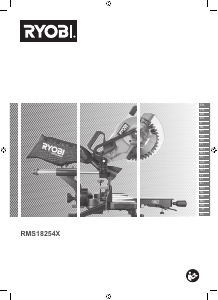
Mode d’emploi Ryobi RMS18254X-0 Scie à onglet

Besoin d'un mode d’emploi pour votre Ryobi RMS18254X-0 Scie à onglet ? Ci-dessous, vous pouvez consulter et télécharger gratuitement le mode d’emploi PDF en français. Ce produit a actuellement 2 questions fréquemment posées, 0 commentaires et 0 votes. Si ce n'est pas le mode d’emploi que vous souhaitez, veuillez nous contacter.

Votre produit est défectueux et le mode d’emploi n’offre aucune solution ? Rendez-vous à un Repair Café pour obtenir des services de réparation gratuits.

Mode d’emploi

Loading…

Never reach into the area near the blade unless the
blade has completely stopped.
Before use, thoroughly check the product and battery
pack for any damage or material fatigue. Repairs to
the whole product should only be carried out by an
authorised service centre.
Always use the guards on the product. Do not use
the product if the guards are not in place and working
correctly.
The lower blade guard should only open when the blade
is lowered to the workpiece and must always be able to
move freely and close automatically.
Always fix and use extension bars for workpiece support
during operation.
Never alter of modify the product or its function. Your
safety may be compromised.
Do not use saw blades which are cracked, damaged or
deformed.
Do not use saw blades made of high-speed steel.
Only use blades that are sharp. Replace dull blades.
Always use blades with correct size and shape of arbour
holes. Blades that do not match the mounting hardware
of the saw will run eccentrically, causing loss of control.
Use only woodworking blades specified in this manual,
which comply with EN 847-1.
Do not use any flanges, washers and nuts to secure the
saw blade other than those supplied or indicated in the
instruction manual.
It is necessary to select a saw blade which is suitable
for the material being cut. Never use the product to cut
materials other than those specified in the intended use
section in this manual.
It is important to avoid overheating the blade and melting
the plastic when cutting.
It is essential to adhere to the maximum speed specified
on the saw blade, only use saw blades that are marked
with a speed equal or higher than the speed marked on
the tool.
Replace the table insert when worn or damaged.
Before work, make a dummy cut without the motor turned
on so the position of the blade, operation of the guards
with respect to other machine parts, and workpiece may
be checked.
When performing mitre, bevel or compound mitre cuts,
adjust the sliding fence or sub-fence to ensure the
correct clearance from the blade.
Avoid uncontrolled release of the saw unit from the fully
down position.
The handle lock must always be engaged when
transporting the product.
Keep the floor area free of loose materials, such as chips
and cut-offs.
Refrain from removing any cut-offs or other parts of the
workpiece from the cutting area whilst the product is
running and the saw head is not in the rest position.
Long workpieces must be adequately supported. The
working area of the saw includes the whole extent of the
workpiece. The operator should secure this area from
accidental contact from other persons or objects which
may move the workpiece during operation.
The dust produced when using the product may be
harmful to health. Use a dust suction system and wear
a suitable dust protection mask. Remove deposited dust
thoroughly with a vacuum cleaner.
It may be necessary to adjust the sliding fence to ensure
proper clearance prior to making a bevel or compound
cut. Make sure the sliding fence lock screw is tightened
securely after the adjustment.
The clamp can be installed and used on either side of
the blade. In some operation, the clamp may interfere
with the blade guard assembly. Always make sure there
is no interference with the blade guard prior to beginning
any cutting operation to reduce the risk of serious
personal injury.
Ambient temperature range for tool during operation is
between 0 ˚C and 40˚ C.
Ambient temperature range for tool storage is between
0 ˚C and 40˚ C.
The recommended ambient temperature range for the
charging system during charging is between 10 ˚C and
38˚ C.
ADDITIONAL BATTERY SAFETY WARNINGS
To reduce the risk of fire, personal injury, and product
damage due to a short circuit, never immerse your
tool, battery pack or charger in fluid or allow a fluid to
flow inside them. Corrosive or conductive fluids, such
as seawater, certain industrial chemicals, and bleach
or bleach-containing products, etc., can cause a short
circuit.
Ambient temperature range for battery during use is
between 0 ˚C and 40˚ C.
Ambient temperature range for battery storage is
between 0 ˚C and 20˚ C.
TRANSPORTING LITHIUM BATTERIES
Transport the battery in accordance with local and national
provisions and regulations.
Follow all special requirements on packaging and labelling
when transporting batteries by a third party. Ensure that
no batteries can come in contact with other batteries
or conductive materials while in transport by protecting
exposed connectors with insulating, non-conductive caps or
tape. Do not transport batteries that are cracked or leaking.
Check with the forwarding company for further advice.
RESIDUAL RISKS
Even when the product is used as prescribed, it is still
impossible to completely eliminate certain residual risk
factors. The following hazards may arise and the operator
should pay special attention to avoid the following:
Risk of contact with uncovered parts of the rotating saw
blade
Kick-back of workpieces or parts of workpieces due to
improper adjustment or handling
Catapulting of faulty carbide tips from the saw blade
Damage to the respiratory system
NOTE: Wear respiratory protection masks containing
filters appropriate to the materials being worked. Ensure
adequate workplace ventilation. Do not eat, drink or
smoke in the work area.
Damage to hearing if effective hearing protection is not
worn.
WARNING! Dust from certain paints, coatings and
materials may cause irritation or allergic reactions to the
6
Original Instructions
Télécharger mode d’emploi en Français (PDF, 16.22 MB)
(Tenez compte de l’environnement et imprimez ce manuel uniquement si c’est vraiment nécessaire)

Loading…

Évaluation

Dites-nous ce que vous pensez du Ryobi RMS18254X-0 Scie à onglet en laissant une note de produit. Vous voulez partager vos expériences avec ce produit ou poser une question ? Veuillez laisser un commentaire au bas de la page.
Etes-vous satisfait du Ryobi RMS18254X-0 Scie à onglet ?
Oui Non
Soyez le premier à évaluer ce produit
0 évaluations

Joignez-vous à la conversation sur ce produit

Ici, vous pouvez partager ce que vous pensez du Ryobi RMS18254X-0 Scie à onglet. Si vous avez une question, lisez d’abord attentivement le mode d’emploi. La demande d’un mode d’emploi peut être effectuée en utilisant notre formulaire de contact.

En savoir plus sur ce mode d’emploi

Nous comprenons qu’il est agréable d’avoir un mode d’emploi papier pour vos Ryobi RMS18254X-0 Scie à onglet. Vous pouvez toujours télécharger le mode d’emploi depuis notre site Web et l’imprimer vous-même. Si vous souhaitez disposer d’un mode d’emploi original, nous vous recommandons de contacter Ryobi. Ils pourront peut-être fournir un mode d’emploi original. Recherchez-vous le mode d’emploi de votre Ryobi RMS18254X-0 Scie à onglet dans une autre langue ? Choisissez votre langue préférée sur notre page d’accueil et recherchez le numéro de modèle pour voir si nous l’avons disponible.

Caractéristiques

Marque Ryobi
Modèle RMS18254X-0
Catégorie Scies à onglets
Type de fichier PDF
Taille du fichier 16.22 MB

Tous les modes d’emploi pour Ryobi Scies à onglets
Plus de modes d’emploi de Scies à onglets

Foire aux questions sur Ryobi RMS18254X-0 Scie à onglet

Notre équipe d’assistance recherche des informations utiles sur les produits et des réponses aux questions fréquemment posées. Si vous trouvez une inexactitude dans notre foire aux questions, veuillez nous le faire savoir en utilisant notre formulaire de contact.

Dois-je porter une protection auditive lorsque j'utilise une scie à onglets ? Vérifié

Oui tu devrais. Bien que la quantité de bruit produite par une scie à onglets puisse varier selon les marques et les modèles, une exposition à long terme à un bruit fort peut provoquer des dommages auditifs permanents. C'est pourquoi il est conseillé de porter une protection auditive.

Cela a été utile (21) En savoir plus

Puis-je ranger des outils électriques dans un hangar ou un garage ? Vérifié

En général, vous pouvez ranger les outils électriques dans un cabanon ou un garage, même s'il y gèle parfois. Cependant, pour préserver la durée de vie de l'outil électrique, il est préférable de le stocker dans un endroit sec et sans variations de température importantes. Dans une remise ou un garage, les différences de température peuvent provoquer la formation de condensation, ce qui peut provoquer de la rouille. De plus, les outils fonctionnant sur piles durent moins longtemps et se chargent moins bien à des températures très basses. Pour être sûr de la manière dont votre outil électrique doit être stocké, lisez toujours attentivement le manuel d'utilisation.

Cela a été utile (21) En savoir plus
Mode d’emploi Ryobi RMS18254X-0 Scie à onglet

Produits connexes

Catégories associées

×
Download