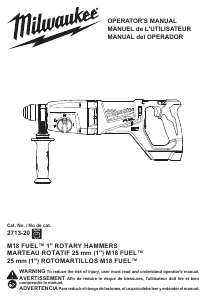
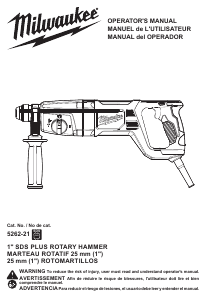
Mode d’emploi Milwaukee 2416-20 Perforateur

Besoin d'un mode d’emploi pour votre Milwaukee 2416-20 Perforateur ? Ci-dessous, vous pouvez consulter et télécharger gratuitement le mode d’emploi PDF en français. Ce produit a actuellement 4 questions fréquemment posées, 0 commentaires et 0 votes. Si ce n'est pas le mode d’emploi que vous souhaitez, veuillez nous contacter.

Votre produit est défectueux et le mode d’emploi n’offre aucune solution ? Rendez-vous à un Repair Café pour obtenir des services de réparation gratuits.

Mode d’emploi

Loading…
4
Using the Control Switch
The control switch may be set to three positions:
forward, reverse and lock. Always allow the motor
to come to a complete stop before using the control
switch to avoid damage to the tool.
For forward (clockwise) rotation, push in the control
switch from the right side of the tool. Check the direc-
tion of rotation before use.
For reverse (counterclockwise) rotation, push in the
control switch from the left side of the tool. Check
direction of rotation before use.
To lock the trigger, push the control switch to the
center position. The trigger will not work while the
control switch is in the center locked position. Always
lock the trigger or remove the battery pack before
performing maintenance, changing accessories,
storing the tool and any time the tool is not in use.
Starting, Stopping and Controlling Speed
1. To start the tool, grasp the handle rmly and pull
the trigger.
NOTE: An LED is turned on when the trigger is
pulled.
2. To vary the speed, increase or decrease the pres-
sure on the trigger. The further the trigger is pulled,
the greater the speed.
3. To stop the tool, release the trigger. Make sure
the tool comes to a complete stop before laying
the tool down.
Operating
Position the tool, grasp the handle rmly and pull
the trigger. Always hold the tool securely to maintain
control. This tool has been designed to achieve top
performance with only moderate pressure. Let the
tool do the work.
If the speed begins to drop o󰀨 when drilling large or
deep holes, pull the bit partially out of the hole while
the tool is running to help clear dust. Do not use water
to settle the dust since it will clog the bit utes and
tend to make the bit bind in the hole. If the bit should
bind, stop the tool, free the bit and begin again.
APPLICATIONS
WARNING
To reduce the risk of electric shock,
check work area for hidden pipes
and wires before drilling or driving screws.
Selecting Bits
When selecting a bit, use the right type for your job.
For best performance, always use sharp bits.
Drilling
1. Before drilling, be sure the workpiece is clamped
securely. Use backing material to prevent damage
to the workpiece during breakthrough.
2. When starting a hole, place the drill bit on the work
surface and apply rm pressure. Begin drilling at
a slow speed, gradually increasing the speed as
you drill.
3. Always apply pressure in line with the bit. Use
enough pressure to keep the drill biting, but do
not push hard enough to stall the motor.
4. Reduce pressure and ease the bit through the last
part of the hole. While the tool is still running, pull
the bit out of the hole to prevent jamming.
ASSEMBLY
WARNING
Recharge only with the charger
specied for the battery. For spe-
cic charging instructions, read the operators
manual supplied with your charger and battery.
Removing/Inserting the Battery
To remove the battery, push in the release buttons
and pull the battery pack away from the tool.
WARNING
Always remove battery pack before
changing or removing accessories.
To insert the battery, slide the pack into the body
of the tool. Make sure it latches securely into place.
WARNING
Only use accessories specically
recommended for this tool. Others
may be hazardous.
Installing Bits
NOTE: Only use accessories with SDS or SDS Plus
shanks.
Be sure that the shank of the bit is clean. Dirt particles
may cause the bit to line up improperly. Do not use
bits larger than the maximum recommended capacity
of the drill because gear damage or motor overload-
ing may result. For best performance, be sure that
the bit is properly sharpened and the shank is lightly
greased before use.
1. Insert the bit into the nose of the tool.
2. Rotate bit slowly until it aligns with the locking
mechanism.
3. Push bit into tool until it locks.
4. Check that the bit is locked properly; it should be pos-
sible to pull the bit back and forth slightly (about 1/4").
5. To remove bits, pull bit holder release collar toward
the rear of tool and remove bit.
NOTE: Use caution when handling hot bits.
OPERATION
WARNING
Always remove battery pack before
changing or removing accesso-
ries. Only use accessories specically recom-
mended for this tool. Others may be hazardous.
To reduce the risk of injury, keep hands away
from the bit and all moving parts. Always wear
safety goggles or glasses with side shields.
To reduce the risk of injury, wear a dust mask or
use an OSHA compliant dust extraction solution
when working in dusty situations.
Fuel Gauge
To determine the amount of charge left in the bat-
tery, pull the trigger. The Fuel Gauge will light up for
2-3 seconds.
To signal the end of charge, 1 light on the fuel gauge
will ash for 2-3 seconds.
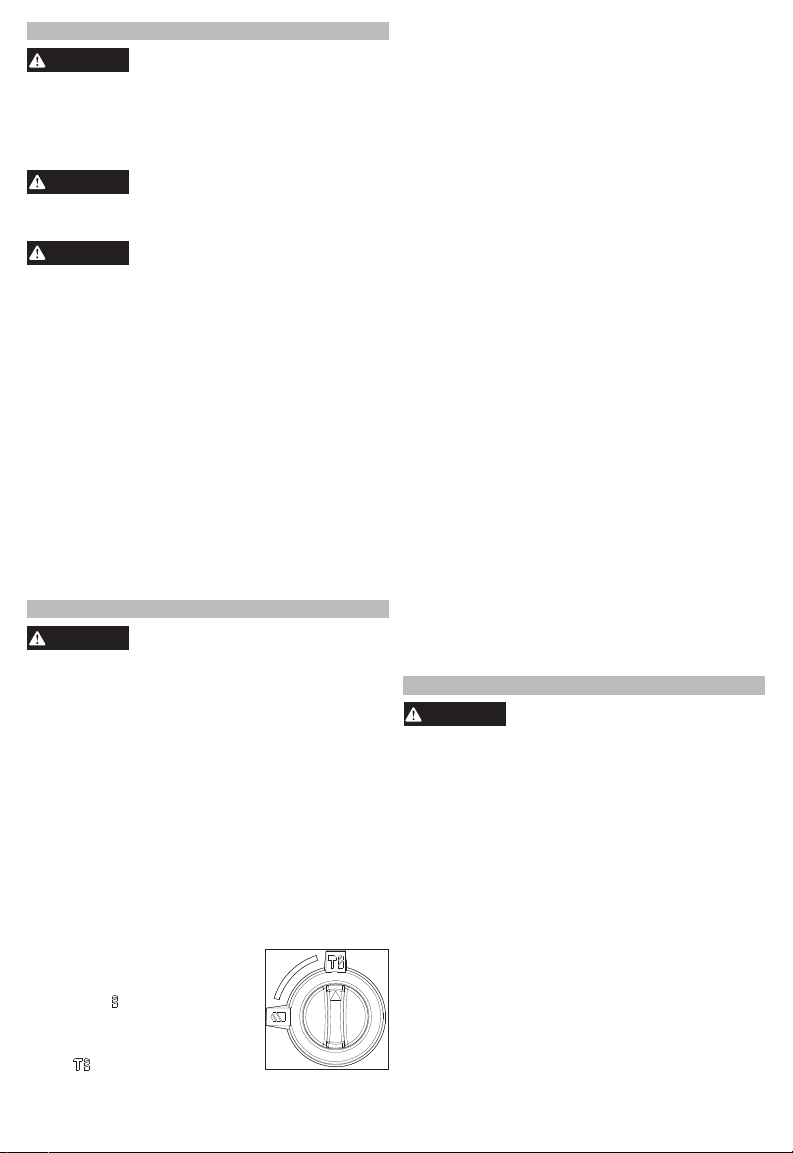
Selecting Action
Always allow the motor to come to a complete stop
before changing the mode selection to avoid damage
to the tool.
1. For drilling, turn the mode se-
lector so the arrow points to the
twist drill
symbol.
2. For rotary hammering, turn the
mode selector so the arrow
points to the hammer and twist
drill
symbol.
NOTE: To engage the hammering mechanism, main-
tain pressure on the bit. When pressure on the bit is
released, the hammering action will stop.
Télécharger mode d’emploi en Français (PDF, 1.18 MB)
(Tenez compte de l’environnement et imprimez ce manuel uniquement si c’est vraiment nécessaire)

Loading…

Évaluation

Dites-nous ce que vous pensez du Milwaukee 2416-20 Perforateur en laissant une note de produit. Vous voulez partager vos expériences avec ce produit ou poser une question ? Veuillez laisser un commentaire au bas de la page.
Etes-vous satisfait du Milwaukee 2416-20 Perforateur ?
Oui Non
Soyez le premier à évaluer ce produit
0 évaluations

Joignez-vous à la conversation sur ce produit

Ici, vous pouvez partager ce que vous pensez du Milwaukee 2416-20 Perforateur. Si vous avez une question, lisez d’abord attentivement le mode d’emploi. La demande d’un mode d’emploi peut être effectuée en utilisant notre formulaire de contact.

En savoir plus sur ce mode d’emploi

Nous comprenons qu’il est agréable d’avoir un mode d’emploi papier pour vos Milwaukee 2416-20 Perforateur. Vous pouvez toujours télécharger le mode d’emploi depuis notre site Web et l’imprimer vous-même. Si vous souhaitez disposer d’un mode d’emploi original, nous vous recommandons de contacter Milwaukee. Ils pourront peut-être fournir un mode d’emploi original. Recherchez-vous le mode d’emploi de votre Milwaukee 2416-20 Perforateur dans une autre langue ? Choisissez votre langue préférée sur notre page d’accueil et recherchez le numéro de modèle pour voir si nous l’avons disponible.

Caractéristiques

Marque Milwaukee
Modèle 2416-20
Catégorie Perforateurs
Type de fichier PDF
Taille du fichier 1.18 MB

Tous les modes d’emploi pour Milwaukee Perforateurs
Plus de modes d’emploi de Perforateurs

Foire aux questions sur Milwaukee 2416-20 Perforateur

Notre équipe d’assistance recherche des informations utiles sur les produits et des réponses aux questions fréquemment posées. Si vous trouvez une inexactitude dans notre foire aux questions, veuillez nous le faire savoir en utilisant notre formulaire de contact.

Quelle est la différence entre une perceuse à percussion et un perforateur ? Vérifié

Les perceuses à percussion peuvent être utilisées pour percer des trous dans les murs en briques ou en mortier. Pour percer des trous dans les murs en béton, vous avez besoin d'un perforateur.

Cela a été utile (260) En savoir plus

Que signifie Joule (J) par rapport aux marteaux rotatifs ? Vérifié

Le nombre de Joule indique l’énergie d’impact du marteau rotatif. Pour percer des trous réguliers dans le béton, un marteau rotatif de 2,2 J est suffisant.

Cela a été utile (219) En savoir plus

Dois-je porter une protection auditive lorsque j'utilise une perceuse ? Vérifié

Oui, vous devriez. Bien que la quantité de bruit produite par une perceuse varie selon les marques et les modèles, une exposition prolongée aux bruits forts peut entraîner des lésions auditives permanentes. C'est pourquoi il est judicieux de porter une protection auditive.

Cela a été utile (138) En savoir plus

Puis-je ranger des outils électriques dans un hangar ou un garage ? Vérifié

En général, vous pouvez ranger les outils électriques dans un cabanon ou un garage, même s'il y gèle parfois. Cependant, pour préserver la durée de vie de l'outil électrique, il est préférable de le stocker dans un endroit sec et sans variations de température importantes. Dans une remise ou un garage, les différences de température peuvent provoquer la formation de condensation, ce qui peut provoquer de la rouille. De plus, les outils fonctionnant sur piles durent moins longtemps et se chargent moins bien à des températures très basses. Pour être sûr de la manière dont votre outil électrique doit être stocké, lisez toujours attentivement le manuel d'utilisation.

Cela a été utile (69) En savoir plus
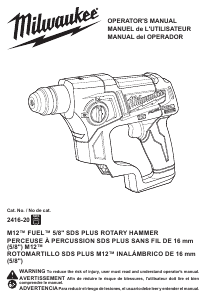
Mode d’emploi Milwaukee 2416-20 Perforateur

Produits connexes

Catégories associées

×
Download