Mode d’emploi Milwaukee 5363-21 Perforateur

Besoin d'un mode d’emploi pour votre Milwaukee 5363-21 Perforateur ? Ci-dessous, vous pouvez consulter et télécharger gratuitement le mode d’emploi PDF en français. Ce produit a actuellement 4 questions fréquemment posées, 0 commentaires et 0 votes. Si ce n'est pas le mode d’emploi que vous souhaitez, veuillez nous contacter.

Votre produit est défectueux et le mode d’emploi n’offre aucune solution ? Rendez-vous à un Repair Café pour obtenir des services de réparation gratuits.

Mode d’emploi

Loading…
4
5
SPECIFIC SAFETY RULES
Wear ear protectors. Exposure to noise can
cause hearing loss.
Use auxiliary handle(s), if supplied with the
tool. Loss of control can cause personal injury.
Hold power tools by insulated gripping surfaces,
when performing an operation where the cutting
tool may contact hidden wiring or its own cord.
Cutting accessory contacting a live wire may make
exposed metal parts of the power tool live and could
give the operator an electric shock.
Keep hands away from all cutting edges and
moving parts.
Maintain labels and nameplates. These carry
important information. If unreadable or missing,
contact a MILWAUKEE service facility for a free
replacement.
WARNING: Some dust created by power sanding,
sawing, grinding, drilling, and other construction
activities contains chemicals known to cause
cancer, birth defects or other reproductive harm.
Some examples of these chemicals are:
lead from lead-based paint
crystalline silica from bricks and cement and other
masonry products, and
arsenic and chromium from chemically-treated
lumber.
Your risk from these exposures varies, depending
on how often you do this type of work. To reduce
your exposure to these chemicals: work in a well
ventilated area, and work with approved safety
equipment, such as those dust masks that are spe-
cially designed to lter out microscopic particles.
Fig. B
Fig. C
Fig. A
GROUNDING
WARNING Improperly connecting the
grounding wire can result in the risk of
electric shock. Check with a quali ed electri-
cian if you are in doubt as to whether the
outlet is properly grounded. Do not modify
the plug provided with the tool. Never remove
the grounding prong from the plug. Do not
use the tool if the cord or plug is damaged. If
damaged, have it repaired by a MILWAUKEE
service facility before use. If the plug will not
t the outlet, have a proper outlet installed by
a quali ed electrician.
Grounded Tools: Tools with Three Prong Plugs
Tools marked “Grounding Required” have a three
wire cord and three prong grounding plug. The
plug must be connected to a properly grounded
outlet (See Figure A). If the tool should electrically
malfunction or break down, grounding provides a
low resistance path to carry electricity away from
the user, reducing the risk of electric shock.
The grounding prong in the plug is connected
through the green wire inside the cord to the
grounding system in the tool. The green wire in the
cord must be the only wire connected to the tool's
grounding system and must never be attached to
an electrically “live” terminal.
Your tool must be plugged into an ap-
propriate outlet, properly installed and
grounded in accordance with all codes
and ordinances. The plug and outlet
should look like those in Figure A.
Double Insulated Tools: Tools with Two Prong
Plugs
Tools marked “Double Insulated” do not require
grounding. They have a special double insula-
tion system which satis es OSHA requirements
and complies with the applicable standards of
Underwriters Laboratories, Inc., the
Canadian Standard Association and
the National Electrical Code. Double
Insulated tools may be used in either
of the 120 volt outlets shown in
Figures B and C.
FUNCTIONAL DESCRIPTION
Grounded tools require a three wire extension
cord. Double insulated tools can use either a two
or three wire extension cord. As the distance from
the supply outlet increases, you must use a heavier
gauge extension cord. Using extension cords with
inadequately sized wire causes a serious drop in
voltage, resulting in loss of power and possible tool
damage. Refer to the table shown to determine the
required minimum wire size.
The smaller the gauge number of the wire, the
greater the capacity of the cord. For example, a 14
gauge cord can carry a higher current than a 16
gauge cord. When using more than one extension
cord to make up the total length, be sure each cord
contains at least the minimum wire size required. If
you are using one extension cord for more than one
tool, add the nameplate amperes and use the sum
to determine the required minimum wire size.
Guidelines for Using Extension Cords
If you are using an extension cord outdoors,
be sure it is marked with the suf x “W-A” (“W”
in Canada) to indicate that it is acceptable for
outdoor use.
Be sure your extension cord is properly wired
and in good electrical condition. Always replace
a damaged extension cord or have it repaired by
a quali ed person before using it.
Protect your extension cords from sharp objects,
excessive heat and damp or wet areas.
READ AND SAVE ALL
INSTRUCTIONS FOR FUTURE USE.
Recommended Minimum Wire Gauge
for Extension Cords*
Extension Cord Length
* Based on limiting the line voltage drop to ve volts
at 150% of the rated amperes.
Nameplate
Amperes
0 - 2.0
2.1 - 3.4
3.5 - 5.0
5.1 - 7.0
7.1 - 12.0
12.1 - 16.0
16.1 - 20.0
25'
18
18
18
18
16
14
12
75'
18
18
16
14
12
10
100'
18
16
14
12
10
150'
16
14
12
12
50'
18
18
18
16
14
12
10
EXTENSION CORDS
SPECIFICATIONS
Tool Capacities
Cat. No.
Volts
AC A
No
Load
RPM
No Load
BPM
Drill Only Rotary Hammer
Twist
Drill Bit
(Steel)
Twist
Drill Bit
(Wood)
Carbide Tipped
Percussion Bit
(concrete)
Thin Wall
Core Bit
(concrete)
Thin Wall
Core Bit
(brick/block)
5363-21 120 7 0-1400
0-5980
1/2" 1-1/4" 1" 2-1/2" 2-5/8"
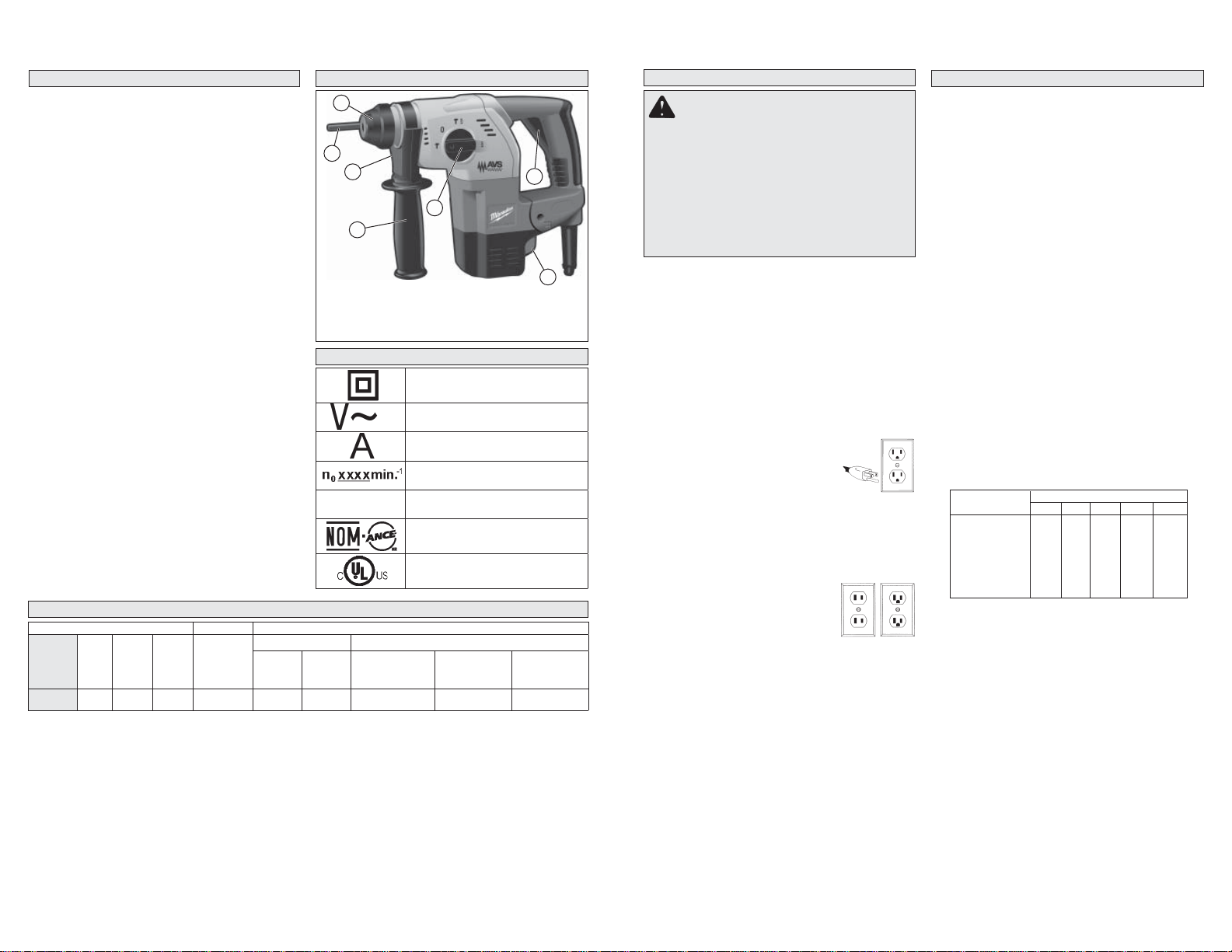
SYMBOLOGY
Double Insulated
Volts Alternating Current
Amps
No Load Revolutions per Minute
(RPM)
BPM
Blows per Minute (BPM)
Mexican Approvals Marking
Underwriters Laboratories, Inc.
United States and Canada
1. Side handle
2. Clamp
3. Depth gauge rod
4. SDS Plus bit holder
5. Trigger
6. Forward/Reverse Control
7. Mode selector lever switch
2
1
3
5
4
6
7
Télécharger mode d’emploi en Français (PDF, 0.23 MB)
(Tenez compte de l’environnement et imprimez ce manuel uniquement si c’est vraiment nécessaire)

Loading…

Évaluation

Dites-nous ce que vous pensez du Milwaukee 5363-21 Perforateur en laissant une note de produit. Vous voulez partager vos expériences avec ce produit ou poser une question ? Veuillez laisser un commentaire au bas de la page.
Etes-vous satisfait du Milwaukee 5363-21 Perforateur ?
Oui Non
Soyez le premier à évaluer ce produit
0 évaluations

Joignez-vous à la conversation sur ce produit

Ici, vous pouvez partager ce que vous pensez du Milwaukee 5363-21 Perforateur. Si vous avez une question, lisez d’abord attentivement le mode d’emploi. La demande d’un mode d’emploi peut être effectuée en utilisant notre formulaire de contact.

En savoir plus sur ce mode d’emploi

Nous comprenons qu’il est agréable d’avoir un mode d’emploi papier pour vos Milwaukee 5363-21 Perforateur. Vous pouvez toujours télécharger le mode d’emploi depuis notre site Web et l’imprimer vous-même. Si vous souhaitez disposer d’un mode d’emploi original, nous vous recommandons de contacter Milwaukee. Ils pourront peut-être fournir un mode d’emploi original. Recherchez-vous le mode d’emploi de votre Milwaukee 5363-21 Perforateur dans une autre langue ? Choisissez votre langue préférée sur notre page d’accueil et recherchez le numéro de modèle pour voir si nous l’avons disponible.

Caractéristiques

Marque Milwaukee
Modèle 5363-21
Catégorie Perforateurs
Type de fichier PDF
Taille du fichier 0.23 MB

Tous les modes d’emploi pour Milwaukee Perforateurs
Plus de modes d’emploi de Perforateurs

Foire aux questions sur Milwaukee 5363-21 Perforateur

Notre équipe d’assistance recherche des informations utiles sur les produits et des réponses aux questions fréquemment posées. Si vous trouvez une inexactitude dans notre foire aux questions, veuillez nous le faire savoir en utilisant notre formulaire de contact.

Quelle est la différence entre une perceuse à percussion et un perforateur ? Vérifié

Les perceuses à percussion peuvent être utilisées pour percer des trous dans les murs en briques ou en mortier. Pour percer des trous dans les murs en béton, vous avez besoin d'un perforateur.

Cela a été utile (260) En savoir plus

Que signifie Joule (J) par rapport aux marteaux rotatifs ? Vérifié

Le nombre de Joule indique l’énergie d’impact du marteau rotatif. Pour percer des trous réguliers dans le béton, un marteau rotatif de 2,2 J est suffisant.

Cela a été utile (219) En savoir plus

Dois-je porter une protection auditive lorsque j'utilise une perceuse ? Vérifié

Oui, vous devriez. Bien que la quantité de bruit produite par une perceuse varie selon les marques et les modèles, une exposition prolongée aux bruits forts peut entraîner des lésions auditives permanentes. C'est pourquoi il est judicieux de porter une protection auditive.

Cela a été utile (138) En savoir plus

Puis-je ranger des outils électriques dans un hangar ou un garage ? Vérifié

En général, vous pouvez ranger les outils électriques dans un cabanon ou un garage, même s'il y gèle parfois. Cependant, pour préserver la durée de vie de l'outil électrique, il est préférable de le stocker dans un endroit sec et sans variations de température importantes. Dans une remise ou un garage, les différences de température peuvent provoquer la formation de condensation, ce qui peut provoquer de la rouille. De plus, les outils fonctionnant sur piles durent moins longtemps et se chargent moins bien à des températures très basses. Pour être sûr de la manière dont votre outil électrique doit être stocké, lisez toujours attentivement le manuel d'utilisation.

Cela a été utile (69) En savoir plus
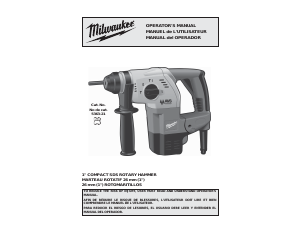
Mode d’emploi Milwaukee 5363-21 Perforateur

Produits connexes

Catégories associées

×
Download